

October 2026 San Francisco Bay Area Real Estate – Market Trends & Insights
California’s housing market is entering the final months of 2026 with a mix of challenges and opportunities. Rising mortgage rates, persistent inflation, and higher energy costs are putting pressure on household budgets and homebuying affordability. While home sales have slowed statewide, home prices remain relatively resilient, with several Bay Area counties recording notable year-over-year gains.
For buyers, sellers, and property owners, the latest market data highlights an increasingly localized housing market. Some counties are experiencing stronger sales and price appreciation, while others are seeing slower activity and softer prices. Understanding these differences can help homeowners make informed decisions as the market moves toward 2027.
1. California Home Sales Slow as Mortgage Rates Pressure Buyers
California’s housing market experienced a significant slowdown in September, as existing single-family home sales fell to their lowest level since January. Sales declined 3.4% from August to a seasonally adjusted annualized rate of 260,410 homes, representing a 6.5% decrease compared with September 2025.
Pending sales also weakened, falling 12.1% month over month and 15.8% year over year. These declines suggest that elevated borrowing costs and affordability concerns continue to influence buyers’ decisions. Although statewide existing home sales remained slightly higher on a year-to-date basis through September, the recent slowdown signals that momentum remains fragile.
Higher mortgage rates can significantly affect purchasing power, particularly for first-time buyers and households financing a large portion of their home purchase. Some prospective buyers may delay their plans, look for less expensive properties, or wait for more favorable financing conditions.
For Bay Area sellers, this environment makes competitive pricing, strong property presentation, and realistic expectations increasingly important. Buyers, meanwhile, may benefit from taking time to compare financing options and evaluate properties carefully rather than rushing into a purchase.
2. Bay Area Home Prices Show Different Trends Across Counties
Despite slower statewide sales, California home prices have remained relatively stable. The median price of existing single-family homes declined just 0.2% from August to $899,720 in September, while remaining 1.7% higher than a year earlier.
The Bay Area, however, continues to show considerable variation from county to county. September 2026 data reveals that some markets are gaining value while others are experiencing modest monthly declines or annual price adjustments.
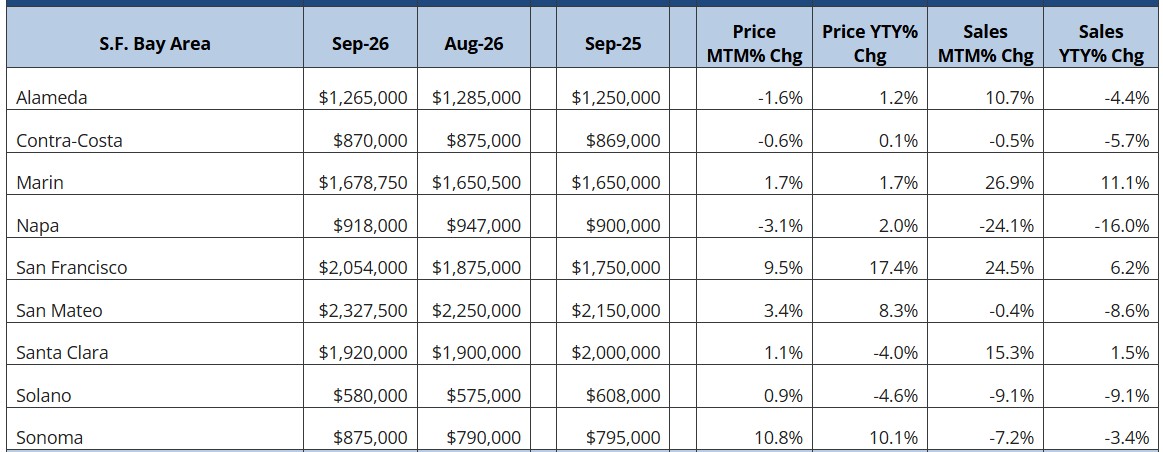
San Francisco recorded one of the strongest annual price gains, with its median home price reaching $2.054 million, up 17.4% from September 2025. San Mateo also posted substantial annual appreciation, while Sonoma experienced a sharp monthly increase and a 10.1% year-over-year gain.
In contrast, Santa Clara and Solano recorded annual price declines of 4.0% and 4.6%, respectively. Contra Costa prices remained nearly unchanged from a year earlier, suggesting a more stable but slower-moving market.
These differences reinforce an important point: the Bay Area is not one housing market. Local inventory, buyer demand, property types, neighborhood characteristics, and price ranges can all influence performance.
For sellers, countywide trends offer useful context, but recent comparable sales in the immediate neighborhood provide a more reliable starting point for pricing. Buyers should also evaluate individual properties and local market conditions rather than assuming every area is appreciating at the same pace.
3. Mortgage Rates Continue to Challenge Housing Affordability
Mortgage rates remain a major factor influencing housing activity as 2026 draws to a close. Even when home prices hold steady, higher borrowing costs can increase monthly payments and reduce the amount buyers can comfortably afford.
As of October 20, 2026, the mortgage examples provided for this market update show the following rates:
30-year fixed conventional loan: 7.49% interest rate, with a 7.697% APR.
15-year fixed conventional loan: 6.875% interest rate, with a 7.185% APR.
These examples assume a $275,000 mortgage, a 20% down payment, and specified discount points paid at closing. The estimated principal-and-interest payment is $1,920.96 per month for the 30-year loan and $2,452.60 for the 15-year loan. Taxes, insurance, and other housing costs are not included.
Actual rates and payments vary based on credit history, loan terms, lender requirements, points, and other transaction details. These figures are illustrative examples, not guaranteed offers or a comprehensive measure of the market's average mortgage rate.
For Bay Area buyers, where home prices are often well above the national median, even modest rate changes can have a substantial effect on affordability. Buyers should consider their complete monthly housing costs, explore available financing options, and obtain current loan estimates before making an offer.
For homeowners considering a sale, higher rates may also affect the size of the buyer pool and the offers a property receives. Pricing a home appropriately and preparing it for market can help sellers remain competitive.
4. Inflation and Energy Costs Keep Economic Uncertainty Elevated
Inflation remains an important concern for households and the broader economy. The September consumer price report showed headline inflation rising 0.6% month over month and 3.7% year over year, exceeding the 3.6% annual increase expected by economists.
Higher energy costs were a major contributor, with gasoline prices rising sharply compared with the previous year. Core inflation, which excludes food and energy, increased 0.2% monthly and 2.6% annually. Shelter costs also rose 0.4% from August, marking their fastest monthly increase in five months.
For homeowners and renters, rising everyday expenses can leave less room in the household budget for mortgage payments, rent, utilities, maintenance, and other housing-related costs. Property owners may also face higher operating expenses, making it increasingly important to plan for repairs, insurance, and ongoing maintenance.
Inflation can also influence the Federal Reserve's interest-rate decisions, although mortgage rates do not move in lockstep with the federal funds rate. Bond-market conditions, inflation expectations, and broader economic developments also affect mortgage pricing.
Until inflation shows more sustained improvement, buyers and property owners should prepare for continued uncertainty in financing and household expenses.
5. Consumer Spending Remains Resilient, but Small Businesses Are Cautious
Despite higher living costs, U.S. consumer spending continued to show resilience in September. Retail and food services sales increased 0.8% from August following a 1.3% increase in the previous month. Sales were also up 6.3% year over year.
However, some of that growth reflected higher gasoline prices rather than a broad increase in purchasing power. Excluding gasoline stations, retail sales rose 4.5% compared with the previous year. Spending on essential goods also remained relatively subdued, highlighting the pressure that rising everyday expenses can place on households.
Meanwhile, small business confidence weakened. The National Federation of Independent Business Small Business Optimism Index fell for a second consecutive month, dropping 0.8 points to 97.9 in September, slightly below its long-term average of 98.0.
Higher operating costs, borrowing expenses, hiring challenges, and economic uncertainty continue to weigh on business owners. These pressures can influence hiring, expansion plans, and investment decisions, potentially affecting local economic activity and housing demand.
For the Bay Area, where housing demand is closely connected to employment opportunities, business growth, and household confidence, these economic indicators are worth monitoring. A more cautious business environment does not automatically signal a housing downturn, but it can contribute to slower decision-making among buyers and sellers.
6. What These Trends Mean for Bay Area Buyers, Sellers, and Property Owners
The latest data suggests that the housing market is becoming more dependent on local conditions and individual financial circumstances. While some areas continue to experience price growth, higher mortgage rates and persistent living costs are making affordability a central consideration.
For buyers: Focus on what you can comfortably afford, compare mortgage options, and evaluate recent comparable sales. A slower market in some areas may create opportunities to negotiate, but desirable properties can still command strong prices.
For sellers: Avoid relying solely on past appreciation when setting your asking price. Review current neighborhood sales, prepare your property carefully, and work with a real estate professional who understands local buyer demand and competition.
For landlords and rental property owners: Review your operating expenses, plan for routine maintenance, and evaluate your property's rental performance against current local conditions. In a changing economic environment, proactive management and informed financial planning can help protect your long-term investment.
For homeowners considering their next move: Compare the full cost of buying, selling, holding, or renting before making a decision. Mortgage rates, transaction costs, property taxes, insurance, and future maintenance needs can all affect the outcome.
Looking Ahead: What Could the Market Bring in Early 2027?
California's housing market faces several competing forces as the year comes to an end. Higher mortgage rates, inflation, and cautious business sentiment could continue to restrain sales activity. At the same time, relatively stable statewide home prices and continued appreciation in select Bay Area counties suggest that demand remains present in certain local markets.
A reduction in geopolitical tensions and energy-price pressures could help ease inflation over time, potentially improving economic confidence and lending conditions. However, the timing and extent of any improvement remain uncertain, and mortgage rates may not decline quickly even if inflation moderates.
For Bay Area buyers, sellers, and property owners, the best approach is to stay informed, understand the conditions in your specific market, and make decisions based on your financial goals rather than broad predictions.
At The Cal Agents, we believe that understanding local market trends is essential to making confident real estate decisions. Whether you are planning to buy, sell, or manage a rental property, our team can help you evaluate your options and navigate the changing Bay Area real estate landscape.
