

June 2026 San Francisco Bay Area Real Estate – Market Trends & Insights
The California housing market continues to navigate a complex economic environment in 2026. Elevated mortgage rates, affordability challenges, and slower construction activity remain obstacles for buyers and sellers alike. At the same time, recent improvements in home sales, rising home values, and strong consumer spending indicate that buyer demand remains present beneath the surface.
While interest rate volatility may continue in the near term due to inflation concerns, Federal Reserve policy decisions, and global geopolitical events, the overall outlook for California real estate remains encouraging. If mortgage rates begin to ease and economic conditions remain stable, market activity could strengthen significantly during the second half of the year.
Federal Reserve Holds Rates Steady, But Signals a Cautious Outlook
The Federal Reserve recently voted unanimously to leave its benchmark interest rate unchanged. However, updated economic projections suggest that policymakers remain concerned about persistent inflation and may keep rates higher for longer than previously anticipated.
Following the announcement, bond yields and mortgage rates experienced short-term increases before stabilizing. Ongoing geopolitical uncertainty, including developments involving U.S.-Iran diplomatic negotiations, continues to influence financial markets and mortgage rate movements.
For prospective homebuyers, this means mortgage rates may remain unpredictable in the coming weeks. Nevertheless, many economists still anticipate gradual improvement later in the year if inflation continues to moderate.
California Home Sales Continue Annual Growth
California existing home sales recorded their second consecutive year-over-year increase in May, marking the strongest annual sales growth in eight months.
Statewide sales reached an annualized pace of 268,810 homes, representing a 5.1% increase compared to May 2025. While sales activity softened slightly from April levels, the year-over-year gains demonstrate that buyers are returning to the market despite affordability pressures.
However, there are signs that buyer momentum may be slowing. Pending sales declined 2.2% compared to the same period last year, ending a four-month streak of annual growth.
Looking ahead, lower mortgage rates could help reignite demand during the third and fourth quarters of 2026. Improved economic stability and easing geopolitical tensions may further support buyer confidence.
California Home Prices Reach a New Record High
Home values across California continue to demonstrate remarkable resilience.
The statewide median home price climbed to a record-breaking $930,260 in May, surpassing the previous month by 2.3% and increasing 3.1% from one year earlier. This marks the strongest annual price growth since early 2025 and reflects continued demand for housing throughout the state.
Seasonal market trends typically support higher prices during the spring and summer months. However, affordability concerns and elevated borrowing costs may moderate future price growth as the year progresses.
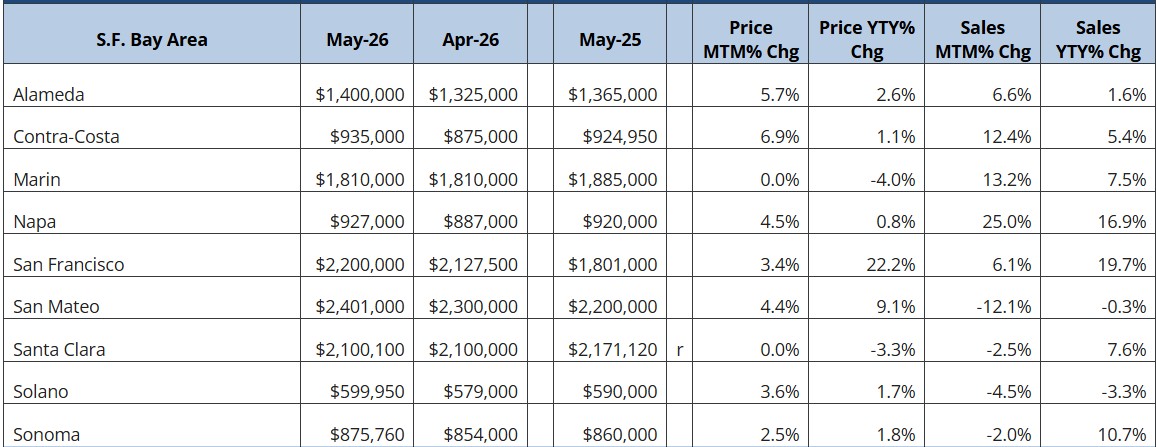
For homeowners considering selling, current market conditions continue to provide strong equity opportunities, particularly in desirable Bay Area communities.
Consumer Spending Remains Strong
Despite higher borrowing costs and inflationary pressures, American consumers continue to spend.
Retail sales increased 6.9% year-over-year in May, representing the strongest growth since January 2023. Even after excluding gasoline purchases, spending still rose an impressive 5.4% compared to last year.
Several factors contributed to the increase, including stronger automobile sales and larger tax refunds earlier in the year. Continued consumer spending is an encouraging sign for the broader economy and helps support housing market stability.
A healthy labor market and resilient household finances remain important factors that could help sustain housing demand throughout the remainder of 2026.
New Construction Slows as Builders Face Challenges
Residential construction remains one of the housing market's weakest areas.
National housing starts declined sharply in May, falling 15.4% from April and reaching their lowest level in six years. Multifamily construction experienced the steepest drop, while single-family housing starts also moved lower.
Builders continue to face several challenges, including:
Elevated financing costs
Rising material prices
Ongoing labor shortages
Soft buyer demand for new construction
Builder confidence also remains subdued. According to recent industry surveys, more builders are reducing prices and offering incentives to attract buyers.
As a result, new housing inventory may remain limited in the coming months, which could continue supporting home prices in many California markets.
What This Means for Bay Area Buyers and Sellers
For buyers, patience and preparation remain key. Mortgage rates may fluctuate in the short term, but opportunities could emerge if rates gradually decline later this year. Buyers who are financially prepared may find less competition compared to previous market cycles.
For sellers, record-high home prices and limited housing inventory continue to create favorable conditions. Well-presented and strategically priced homes are still attracting strong interest, particularly in desirable Bay Area neighborhoods.
At The CAL Agents Realty, we believe the California housing market is showing encouraging signs of resilience. While challenges remain, improving sales activity, rising home values, and strong consumer spending suggest that the foundation for a stronger second half of 2026 is already taking shape.
Whether you're buying, selling, or investing, our team is here to help you navigate today's market with confidence.
Thinking about making a move in the Bay Area? Contact The CAL Agents Realty today for a personalized market consultation.
